
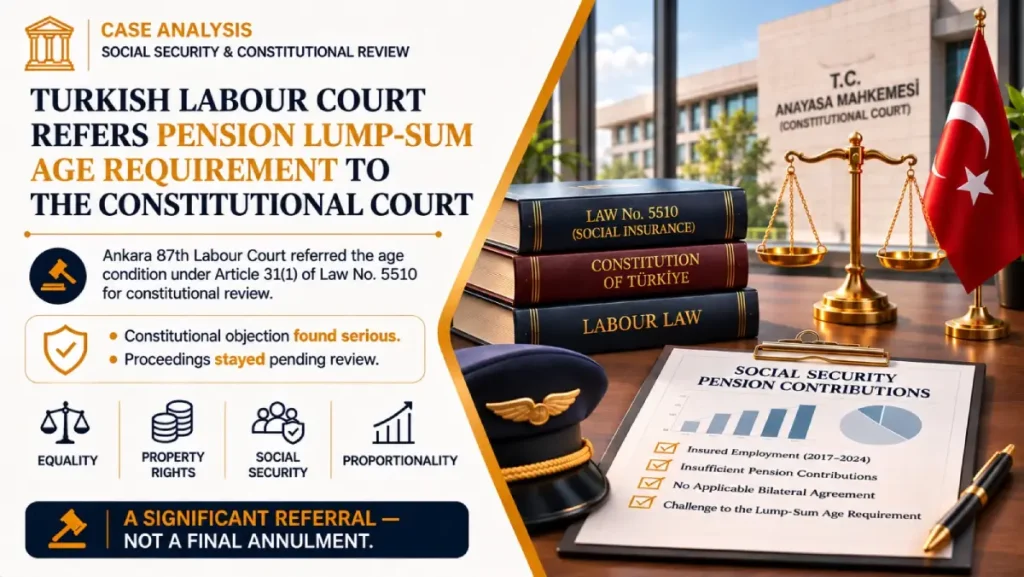
The Ankara 87th Labour Court referred the age requirement in Article 31(1) of Law No. 5510 to the Turkish Constitutional Court after finding a constitutional objection raised by the claimant’s counsel at Pi Legal Consultancy to be serious. The referral arose from a social security dispute in which the claimant’s Turkish contribution record was insufficient for an old-age pension and no applicable agreement allowed him to combine his Turkish and foreign insurance periods.
Introduction
It is helpful to underline at the outset that Article 10 of the Turkish Constitution guarantees equality before the law, and Türkiye’s Foreign Direct Investment Law (Law No. 4875) expressly provides for equal treatment of foreign and domestic investors, subject to applicable statutory and treaty exceptions. Even with these safeguards, foreign nationals can face legal obstacles and unequal outcomes in practice.
A recent interim decision of the 87th Labour Court of Ankara has brought an important provision of Turkish social-security legislation before the Constitutional Court. The dispute concerns whether a foreign national, whose insured employment in Türkiye has permanently ended and who cannot qualify for a Turkish old-age pension or combine his Turkish insurance periods with those of another country, may nevertheless be required to wait until reaching retirement age before recovering the relevant long-term insurance contributions.
The case discussed in this article illustrates how a social security rule that applies equally on its face can place a particular burden on a foreign worker who cannot combine Turkish and overseas insurance periods under an applicable regulatory framework. The present article also offers an opportunity to absorb the role of concrete constitutional review.
Following the constitutional objection raised on behalf of the claimant by Pi Legal Consultancy attorneys, the Labour Court found the objection sufficiently serious and referred the disputed statutory provision to the Constitutional Court through the concrete constitutional-review procedure. The decision is particularly significant for foreign employees from countries that do not have a bilateral social-security agreement with Türkiye. It also raises broader constitutional questions concerning proportionality, equality, property rights, the right to social security and the requirements of the social state.
The Notion of Concrete Constitutional Review
Where the difficulty stems from the statutory rule itself, Article 152 of the Constitution allows the first instance courts to stop the case until the publication of the constitutional review by the Constitutional Court on the question of whether the concerned norm is compatible with the Constitution or not.
For a referral to be made under Article 152 of the Constitution, the provision alleged to be unconstitutional must be applicable in the pending case. Under the Constitutional Court’s settled case law, a provision is applicable if it can affect, in either direction, the resolution of a legal issue arising at any stage of the proceedings or the ultimate outcome of the case.
Concrete Constitutional Review in Türkiye: The Age Requirement for Old-Age Lump-Sum Payments under Law No. 5510
In a case, lodged by attorneys, the first instance labour court examines the question of if there is a need for constitutional review of Article Article 31(1) of Law No. 5510 stipulating that
An insured person covered by Article 4(1)(a) or (b), or first insured under Article 4(1)(c) pursuant to this Law, is entitled to a lump-sum payment if they have left their employment or closed their business for any reason and, despite having reached the age required for an old-age pension, qualify for neither an invalidity pension nor an old-age pension.
The payment consists of the annual amounts of contributions for invalidity, old-age and survivors’ insurance reported on the insured person’s behalf under Article 4(1)(a) or (c), or paid by the insured person under Article 4(1)(b), as applicable. The amount attributable to each year is adjusted by applying the actual adjustment coefficient for each year in the period from the year to which the contributions relate to the date of the written request.
Under the provision, an insured person who has left employment or closed their business but cannot qualify for an invalidity or old-age pension may receive certain long-term insurance contributions as a lump-sum payment, provided that the person has reached the age required for an old-age pension.
Factual Basis
The claimant and the client of Pi Legal Consultancy, a Zimbabwean national, lived in Istanbul and worked as a pilot for several aviation companies from May 2017 to 2024. He held valid work and residence permits, and social insurance contributions were paid regularly on his behalf under Law No. 5510 throughout his insured employment in Türkiye.
In November 2024, the claimant’s employer relocated its operations from Türkiye to Dubai, United Arab Emirates. His insured employment in Türkiye ended as a result, and no further Turkish social insurance contributions were paid on his behalf. As his Turkish contribution record was insufficient to qualify for an old-age pension, the claimant attorney from Pi Legal Consultancy applied to the Social Security Institution (SGK) on 24 April 2025 for an old-age lump-sum payment under Article 31 of Law No. 5510. On 15 August 2025, the SGK confirmed that it had rejected the application because the claimant had not reached the statutory age of 60, which he would reach in August 2047.
The application was rejected by the SGK because the claimant had not yet reached the statutory age required for entitlement to an old-age pension.The claimant was therefore placed in an unusual position. His insurance period was insufficient to qualify for a Turkish old-age pension. At the same time, Türkiye had no bilateral social-security agreement with his country of nationality that would permit the aggregation or coordination of his Turkish insurance periods with another national social-security system.
Accordingly, the claimant representatives argued that the Claimant could neither obtain a Turkish pension nor transfer or combine the relevant insurance periods abroad. The claimant, represented by Pi Legal Consultancy, also noted that the claimant was also prevented from receiving a lump-sum payment solely because he had not yet reached the statutory retirement age.The constitutional objection specifically concerns the phrase:“although having reached the age required for entitlement to an old-age pension”
The claimant, represented by Pi Legal Consultancy, argued that applying this requirement without any exception produced a disproportionate result where:
- the individual’s insured employment in Türkiye had permanently ended;
- the accumulated contribution period was insufficient to obtain a Turkish pension;
- the individual could not aggregate the Turkish insurance periods with those of another country;
- the individual had expressly requested the liquidation of the relevant insurance periods; and
- the legislation permitted previously liquidated insurance periods to be reinstated if the person subsequently became insured again.
Subject Matter of the Referral Application by the Court
The present action concerns an old-age lump-sum payment, and the refusal challenged in the proceedings was based on a finding that the conditions laid down in Article 31 of Law No. 5510 had not been met. Given that the claimant’s employment had ended, that his existing contribution days were insufficient to qualify for an old-age pension, and that he had submitted a written application, it is clear that the statutory requirement to have reached the age of 60 is the decisive issue in the case.
The referral application seeks the annulment of the phrase “…despite having reached the age required to qualify for an old-age pension…” in Article 31(1) of the Social Insurance and General Health Insurance Law No. 5510 of 31 May 2006, as amended by Article 19 of Law No. 5754 of 17 April 2008. The referring court considers the contested wording to be applicable in the pending case and contrary to Articles 2, 10, 13, 35 and 60 of the Constitution.
Article 31(1) of Law No. 5510, the provision under review, provides for a lump-sum payment to insured persons covered by Article 4(1)(a) or (b), as well as to persons first insured under Article 4(1)(c) pursuant to that Law, who have left their employment or closed their business for any reason and who, despite having reached the age required for an old-age pension, qualify for neither an invalidity pension nor an old-age pension. The lump-sum payment consists of the long-term insurance contributions specified in Article 31, adjusted by applying the statutory adjustment coefficient.
First Instance Court Preliminary Review
First instance Labour Court
If the provision in question remains in effect, the plaintiff’s request for a lump-sum old-age payment cannot be granted—even if all other requirements are met—due to the age criterion. Conversely, should the provision be found unconstitutional and subsequently annulled, the plaintiff’s request for a lump-sum payment would need to be re-evaluated within the framework of the remaining conditions set forth in the article. Therefore, the rule under challenge is one that would be directly applied in the case at hand.
At the outset of the proceedings, the court made the following finding.
As long as the contested wording remains in force, the claimant’s application for an old-age lump-sum payment cannot be granted because he does not meet the age requirement, even if all the other conditions are satisfied. If the wording is found unconstitutional and annulled, the claimant’s application will have to be reassessed under the remaining conditions of the provision. The contested rule is therefore directly applicable to the case before the court.
On the Merits
In its reasoning, the Ankara 87th Labour Court examined the contested age requirement under five constitutional grounds. Under the principle of a social state governed by the rule of law (Article 2), it questioned whether deferring the lump-sum payment struck a fair balance between the financial sustainability of the social insurance system and the claimant’s social security interests. Under the principle of proportionality (Article 13), it recognised the legitimate aims of protecting future pension entitlements and preserving actuarial balance, but questioned whether the wait was necessary given the claimant’s limited prospects of qualifying for a Turkish pension and the statutory mechanism for reinstating insurance periods after a lump-sum payment. Under the right to property (Article 35), it considered whether deferring access to the statutory payment imposed an individual and excessive burden, without treating the contributions as an immediately payable debt. Under the right to social security (Article 60), it examined whether applying the age condition without exception made it excessively difficult for the claimant to derive any practical benefit from his Turkish insurance record. Under the principle of equality (Article 10), it questioned whether applying the same age requirement to insured persons with and without access to international aggregation was justified in light of the purpose of the rule.
The Labour Court concluded that the disputed phrase constituted the rule directly applicable to the pending case. If the provision remained in force, the claimant’s request would have to be rejected because of the age requirement. If it were annulled, the claim would need to be reconsidered under the remaining conditions of Article 31.
Conclusion: Referral Through Concrete Constitutional Review
Article 152 of the Turkish Constitution permits a court hearing a pending case to refer an applicable legislative provision to the Constitutional Court where the court considers the provision unconstitutional or finds a party’s constitutional objection to be serious. In the present case, the 87th Labour Court of Ankara found the constitutional objection raised on behalf of the claimant to be serious. It consequently referred the disputed wording of Article 31 to the Constitutional Court and stayed the proceedings.
Outcome of the Interim Decision
The 87th Labour Court of Ankara decided:
- to find the claimant’s constitutional objection serious;
- to request the annulment of the relevant wording in Article 31 of Law No. 5510;
- to refer the matter to the Constitutional Court under Article 152 of the Constitution and Article 40 of Law No. 6216;
- to submit the case documents and its reasoned referral decision to the Constitutional Court; and
- to stay the underlying proceedings pending the constitutional review.
Accordingly, the interim decision does not itself annul the statutory age requirement or finally determine the claimant’s entitlement to payment. That issue now depends on the Constitutional Court’s assessment and the subsequent continuation of the proceedings before the Labour Court.
Significance of the Case
The case demonstrates that social-security disputes involving foreign nationals may extend beyond the technical application of contribution and pension rules.Where a foreign individual has permanently left the Turkish insurance system, cannot obtain a Turkish pension and has no international mechanism through which the relevant insurance periods may be preserved or combined, the application of a formally neutral statutory condition may create a disproportionate burden.
The decision is also important from a procedural perspective. A carefully structured constitutional objection can bring the broader validity of the applicable statutory rule before the Constitutional Court rather than limiting the dispute to the legality of an individual administrative decision.
Conclusion
The present case arose from a foreign employee’s inability to obtain any practical benefit from long-term insurance contributions registered during his employment in Türkiye. It is worth reiterating that the 87th Labour Court of Ankara accepted the representatives of the claimant that the statutory age requirement raised serious constitutional questions concerning the social state, equality, proportionality, property rights and the right to social security. It therefore referred the relevant wording of Article 31 of Law No. 5510 to the Constitutional Court. Pi Legal Consultancy attorneys raised and developed the constitutional objection on behalf of the claimant and secured the referral of the contested provision for concrete constitutional review.
The Constitutional Court registered the referral from the Ankara 87th Labour Court as Case E. 2025/39. On 21 October 2026, following its preliminary examination, the Plenary decided to proceed to an examination on the merits.
The Constitutional Court’s eventual decision may have implications extending beyond the individual proceedings, particularly for foreign employees from countries that do not have a bilateral social-security agreement with Türkiye. Until that review is completed, however, the case should properly be described as a significant constitutional referral rather than a final annulment or final award of the claimed payment.